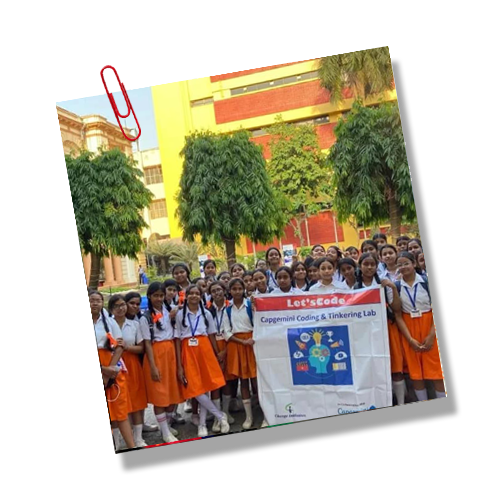
The Let’s Code Project, initiated by Change Initiatives in collaboration with Capgemini, is a commendable endeavor aimed at empowering young minds in 10 government-sponsored schools within the Sonarpur circle. This project targets students ranging from class VI to IX, offering them a unique opportunity to delve into the world of basic computer programming and coding languages such as Scratch and Python.
One of the standout features of the Let’s Code Project is the establishment of dedicated coding labs in each of the participating schools. These labs are equipped with state-of-the-art resources, including computers, projectors, 3D printers, and a range of tinkering items. Such an environment fosters an immersive learning experience and allows students to explore the realms of technology, creativity, and problem-solving. The schools have allotted the class in their existing routine which has helped to run regular training session smoothly. The promotion of STEM careers among girls is a key objective of the programme, with four of the 10 schools girl's schools and three co-ed.
With more than 8,500 students enrolled in this initiative, its impact is widespread and profound. By introducing project-based learning, the Let’s Code Project not only equips students with valuable technical skills but also nurtures their critical thinking and problem-solving abilities. This approach transcends traditional rote learning methods, enabling students to apply their knowledge in practical scenarios. The project is supported by Capgemini.
The project addresses much required expansion of the mental horizon of children. Regular quizzes, drama competitions, theatre competition and workshops, football tournments are held to enrich the children's minds. Tours are organised to science museums to broaden their outlook.
We have now opened our first community Let'sCode club at Sonarpur, which is to the south of Kolkata. Like our Digital Labs, the Community Lab covers a bigger space and is equipped with Arduino boards, sensors, motors, breadboards, and laptops running Arduino IDE, Scratch, and Tinkercad. Students work on real-world projects like automatic lights, obstacle detectors, and irrigation models. The sessions are facilitated by mentors who guide students through interactive, project-based learning.
Change Initiatives has also successfully established four digital classrooms, transforming the learning experience for over 5,000 underprivileged students. Two of these classrooms, equipped with advanced digital boards, are located at Chandaneswar High School in Bhangore and Gobindapur Ratneswar High School near Kolkata. Extending their impact beyond the city, Change Initiatives has also brought digital education to the remote Sundarbans, setting up modern digital classrooms at Rangabelia and Choto Mollakhali of Gosaba block.
.

The Kisholoy Project, spearheaded by Change Initiatives, is a holistic support program aimed at uplifting underprivileged children through education, nutrition, and comprehensive care. Operating across multiple locations – Purulia, Panchanantala (Kolkata), Canning, and Ranaghat – the project plays a vital role in ensuring foundational development for marginalized children.
In the Barabazar block of Purulia, six Sabar Bikash Kendras are currently functional, reaching around 275 tribal children. These centers provide daily remedial classes in subjects like Mathematics, Science, Bengali, and Yoga, while also fostering cultural inclusion through celebrations like Saraswati Puja, Independence Day, Holi, etc.
A key feature of Kisholoy is the provision of nutritious daily tiffins, boosting both health and school attendance. With the active involvement of Barabazar Police Station civic volunteers, learning is further strengthened.
Change Initiatives also extends critical support by offering scholarships, clothing, blankets, lunch on special days, and books to tribal students, including annual scholarships to 20 students in Madhyamik and Higher Secondary levels.
Notably, infrastructure development has also been a focus, with the renovation of the Beldih Sabar School, introducing improved sanitation and vibrant learning spaces. In addition, the organization has supported the Archery Club by providing a bow and arrow, encouraging tribal children to engage in traditional sports.
Another Kisholoy Project runs dedicated educational support for underprivileged children at Panchanantala slum in Kolkata. Every Saturday morning, around 25 pre-primary and primary children receive basic elementary education along with nutritious tiffins, helping build a strong early foundation.
In addition, After School Remedial Classes are conducted on Thursdays, Saturdays, and Sundays, with a special focus on mathematics every Thursday. Currently, around 60 students are benefitting from these remedial sessions, which play a crucial role in strengthening academic skills and fostering community-based learning.
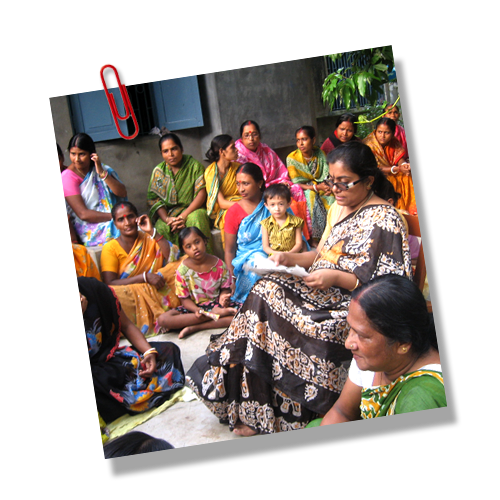
The Nabanna initiative by Change Initiatives is focused on empowering women through skill development, entrepreneurship, digital literacy, and awareness-building.
It began as a small program to help women access information and opportunities through ICT tools, but over time, it has expanded into a comprehensive initiative that supports women in many areas of their lives.
We have provided digital literacy training to more than 1,000 women, helping them build confidence and improve their chances of employment in today’s digital world.
The initiative also supports income-generating activities by promoting ICT-based microenterprises and providing training in tailoring and paper bag making.
In Chhotomollakhali and Kumirmari Gram Panchayats, we have worked with over 100 self-help groups (SHGs) involving more than 1,000 women, helping them engage in mangrove plantation activities and protecting the local ecosystem.
To support long-term livelihoods, we have also introduced animal husbandry programs, offering training in poultry, duck, and goat farming.
In Saguna Gram Panchayat, we have partnered with 140 SHGs to provide training in financial literacy, raise awareness of government schemes, and discuss important issues related to health and gender equality. Across North and South 24 Parganas and Howrah districts, we have worked with SHG leaders and cluster-level representatives to deliver ICT training and support community awareness programs.
In recent years, our focus has been on working intensively with marginalised women poultry farmers in Balarampur, in collaboration with the International Rice Research Institute (IRRI).
These women have taken up backyard poultry farming as a livelihood option, but they continue to face many challenges such as low education levels, limited awareness, minimal decision-making power, and a lack of leadership opportunities.
To support them effectively, we are providing leadership training that helps them understand the qualities of a good leader and equips them to guide their groups with confidence and fairness.
Since they work in self-help groups, strong leadership and good group coordination are essential for collective success. We also offer training on group dynamics — focusing on the importance of teamwork, conflict resolution, shared responsibilities, and mutual support.
Additionally, we conduct gender sensitization sessions that encourage women to question traditional roles and overcome social norms that limit their potential. These sessions help build self-confidence and a sense of equality, both within the family and in the wider community.
We also train these women on how to maintain regular data related to their poultry farming—such as tracking expenses, income, and profits. This financial tracking helps women-led farmer groups clearly understand their monthly earnings, enabling them to make informed decisions and take greater control over their finances.
By combining social empowerment with practical economic training, we are helping these women transform into confident, self-reliant individuals who are not only improving their livelihoods but also emerging as leaders and changemakers in their communities.
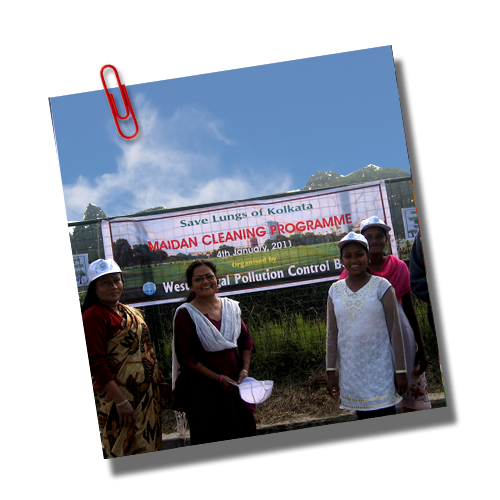
Plant Mangroves, Rebuilt Sunderbans: In recent years, the Sundarbans Forest, one of the world's most critical natural ecosystems, has faced significant degradation due to both manmade activities and the devastating impact of several cyclones. Recognising the urgency of the situation, we embarked on a mission to restore this invaluable treasure by planting 350,000 mangroves across the Chhotomollakhali and Kumirmari Gram Panchayats, and at Nazat, Sandeshkhali.
To ensure the success of our endeavor, we launched extensive awareness campaigns aimed at instilling a sense of responsibility among local communities for the newly planted saplings. Education and engagement have been instrumental in fostering a deeper understanding of the importance of the Sundarbans and the need for their protection.
For effective field-level implementation, we have actively involved local Self-Help Groups (SHGs).More than thousand SHGs women work alongside with us These grassroots people have played a pivotal role in nurturing and safeguarding the newly planted mangroves. Their deep-rooted connections within the community have proven invaluable in our mission.
Our commitment to the Sundarbans continues to grow, as does our hope for a restored and thriving ecosystem. Together with local communities and dedicated SHGs, we are working tirelessly to ensure the Sundarbans remain a symbol of ecological resilience and sustainability. Join us in this vital cause to protect our planet's precious natural heritage.
The mangrove conservation exercise has provided a livelihood option to the SHG women. We are planning to offer more livelihood options to the women in the form of nature-based solutions to fight climate change.
We have simultaneously developed a climate change adaptation framework to build women resilience and drive women agency. The framework is called STIBs (Social, Technical, Innovation Bundles) and have been developed in collaboration with the International Rice Research Institute (IRRI).
STIBs comprise a cluster of learning modules in gender awareness, leadership, heat stress, nutrition that will be integrated with our conservation activities to create a multiplier impact.
The modules have been successfully tested among 175 women poultry farmers in Balrampur a peri-urban region to the south of Kolkata Supported By:Schneider Electric India Foundation, Tellus Carbon, International Rice Research Insititute
Conservation Deck All About STIBs
Mission Million Trees: We planted 17,000 saplings were planted across multiple locations in West Bengal, Assam, Rajasthan, and Gurugram as part of an initiative to promote carbon neutrality cricket match. The endeavor aimed to offset carbon emissions associated with the event. The diverse geographical spread of these plantations underscores the commitment to environmental sustainability. This green initiative not only contributes to carbon reduction but also supports local ecosystems and enhances the overall green cover in these regions. It serves as a commendable step towards aligning sports events with environmental responsibility, setting a positive example for future endeavors.
As part of the Mission Million Tree Programme, we have successfully planted 60,000 saplings, demonstrating our commitment to combat deforestation and safeguard the environment. Our efforts extended to various regions in west Bengal, including Jhargram, Nadia, Hooghly, Purulia, Bankura districts, the Sundarbans, and New Town area. Each sapling has been meticulously geo-tagged on Google Maps, ensuring transparency and accountability throughout the project.. Supported By: Schneider Electric, International Association for Human Values, WWF, Capgemini
Project Well: Providing clean water and sanitation to rural areas poses a pressing challenge. Keeping in mind the 6th sustainable development goal of 'Clean Water and Sanitation', the Change Initiatives Project Well has made a great impact on rural communities and the environment over the years. Preventing arsenic contamination of groundwater with indigenous technology Setting up and maintaining bacteria-free, arsenic-free bi-tech wells with iron-removal filters.At present, there are 166 bi-tech wells for "Arsenic Mukto PanioJawl" in 5 blocks (Baduria, Deganga, Habra, Swarupnagar, and Gaighata) of the North-24 Parganas and one block (Chakdaha) of Nadia, West Bengal, India. As many as 2,500 families and 10,000 consumers use the well on a monthly basis. The project upgrades old dug-wells into modern bore dug-wells (bi-tech wells) that tap water from the upper arsenic-free aquifier Collaborator: Project Well,US
Solar Energy promotion among children villages. Distributing solar lamps among the children of Madandanga and Kantabele villages in Nadia district. Solar lamps can be charged during the day and used for studies in the evenings.
Workshops on disaster management and earthquake at state-government schools in Calcutta. Anti-plastic workshops among SHGs in West Bengal.
Smart Enterprise: Recycle saris into carrybags, a direct campaign against plastic carry bags. We invite donations of old saris, which are turned into bags that can be folded and kept inside smaller bags and pockets. Already more than 1,000 bags have been sold in the market in a month.
Member of Sabuj Mancha network of NGOs
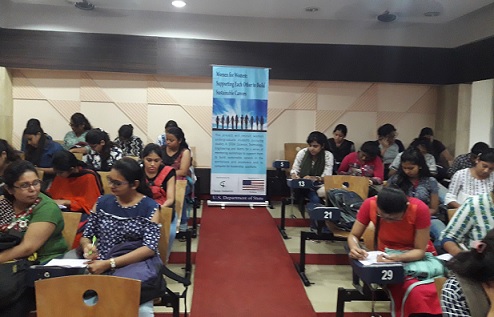
Our Women in STEM project is into its fourth month, and the response has been very encouraging. In this project, we are mentoring 25 women undergraduate students from 7 Kolkata colleges to build a sustainable career in STEM (Science, Technology, Engineering & Math). The project is supported by the American Centre, Kolkata.

Change Initiatives has undertaken a novel effort on environment awareness — we are recycling saris into carry bags. We are inviting donations of old saris, which our girls are turning into bags that can be folded and kept inside smaller bags and pockets.